

Strategy Built Around Contribution: The Order Most Plans Get Backwards
A few years back I sat in on a strategy session for a company that had recently adopted the Balanced Scorecard. They were proud of the move, and rightly so – they had gone looking for a way out of single-gauge, quarter-to-quarter thinking, and here was a framework with four perspectives instead of one. Financial, customer, internal process, learning and growth. The whole leadership team was in the room, energized, ready to build.
They started at the top, with the financial perspective. The revenue target went up on the board first, then margin, then the growth rate they were committing to. From there the discussion moved down. Customer experience came next, framed mostly as how they would deliver on the financial numbers. Then systems and process, the machinery to make that experience efficient. People came last, near the end of the second day, treated as the capacity question: did they have enough hands, enough skill, to run everything above. Four perspectives, worked top to bottom, and I sat there watching each layer get quietly organized around a number.
A revenue target.
A growth rate.
A valuation the plan is meant to reach.
Everything else on the wall is there to serve that number, and the conversation flows in one direction: what do we need to do to get there? It is a reasonable-looking question. It is also, more often than not, the moment the strategy starts to go sideways. Not because defining a financial target in the plan is wrong, but because of where it sits in the order of things.
The traditional approach to strategic planning has taught organizations to build strategy to produce revenue, and then bolt on purpose, people, and contribution afterward as the things you attend to once the financial engine is running. The sequence feels like common sense. Revenue is what keeps the doors open, so revenue comes first, and everything softer waits its turn. But that ordering quietly reverses the actual mechanism of how durable value gets created, and the reversal is where a surprising amount of strategic underperformance is born.
Choosing a Different Approach
The leaders I work with are not naive about this. Many of them can feel that something in the sequence is off. They have hit the wall where a plan that is technically sound, with good market analysis, clear targets, and sensible initiatives, still fails to generate the traction they expected. The people carrying it out are working hard and the numbers still lag. Conversations begin to focus on execution failure, and the temptation in the moment is to push harder, to tighten accountability, to add another dashboard.
Sometimes it helps.
But often the real gap is upstream, in the design. The strategy was built to chase a financial outcome directly, as though revenue were a thing you could aim at and hit. Revenue is not a target you reach by aiming at it. It is a result that follows from something you create for the people your organization serves and the people who do the serving. When a plan is organized around the result instead of the thing that produces the result, it develops a structural blind spot: it stops asking what genuine value the organization is creating, instead asking only how much it can extract from what it already has.
It helps to trace how the blind spot forms, because the mechanism is so ingrained in the process that we’ve stopped questioning it at all. A team sets the financial target first, and every subsequent decision gets measured against it: does this initiative move the number, and how fast? Initiatives that create real value but pay off slowly start to look weak against that filter, while initiatives that pull value forward start to look strong: cut a cost that was doing quiet work, raise a price the market will tolerate for now, defer an investment in the people or capabilities that make the whole thing run. None of those moves is wrong on its own. Stacked together, over enough quarters, they hollow out the very thing that was generating value in the first place. The organization ends up optimizing for extraction from a base it is no longer feeding, and the plan looks disciplined right up until the base gives out.
That is the order most strategies get backwards. Contribution is not the reward you get to enjoy after the financial work is done. Contribution is the financial work. It is the thing that produces the number, not the thing you afford once the number arrives.
Purpose Is Not Just About Revenue
This is the conviction at the center of Quantum Intelligent Strategy: Purpose is not about revenue. It is about contribution. The first of the Four Rules of Quantum Intelligent Strategy states it directly: purpose must be internally compelling and externally valuable in its contribution. Compelling enough to draw genuine commitment from the people inside the organization, and valuable enough to matter to the people outside it.

There are internal and external perspectives at play here. Both halves have to be true at once. A purpose that inspires the team but fails to fill a market need is a nice sentiment. A purpose that serves the market but fails to serve the organization as a living entity will mean nothing to the people inside – it is simply an empty slogan. Contribution must run in both directions.
Notice what this does to the sequence. When purpose is defined as contribution in real terms, something visible and tangible even if it is a stretch, the financial results stop being the thing you chase and become the evidence that the contribution is landing. You are still deeply serious about performance. You are simply serious about it in the right order: value first, and revenue as the signal that the value is real.
The internal and external halves of that rule are not two separate goals competing for attention; they feed each other. When the people inside an organization believe in what they are building, the quality of what they build rises, and the market feels that quality in the product, the service, the way problems get solved. That external value strengthens the organization’s position, which creates the room to invest back into the people and capabilities that produced it, which deepens the internal commitment further. It is a loop that compounds. Break it at either point, disengage the people or stop delivering real value outward, and the loop runs in reverse just as reliably, each turn taking a little more out than it puts back. Strategy designed around contribution is strategy designed to keep that loop turning in the right direction.
This does not ask a leader to care less about financial outcomes – quite the opposite. We live in a monetary system. Leaders have the fiduciary responsibility to ensure that the organization is healthy financially, that its people get paid, that systems are maintained, and that critical infrastructure investments are not deferred. This is not a softer, gentler way to run a business at the expense of results. It is a more accurate account of where results come from. Contribution is not in tension with performance. It is the mechanism that fuels it.
The Ones Keeping Score
Here is where it gets interesting: the people your business serves are already reading the gap I am describing, and they are reading it clearly.
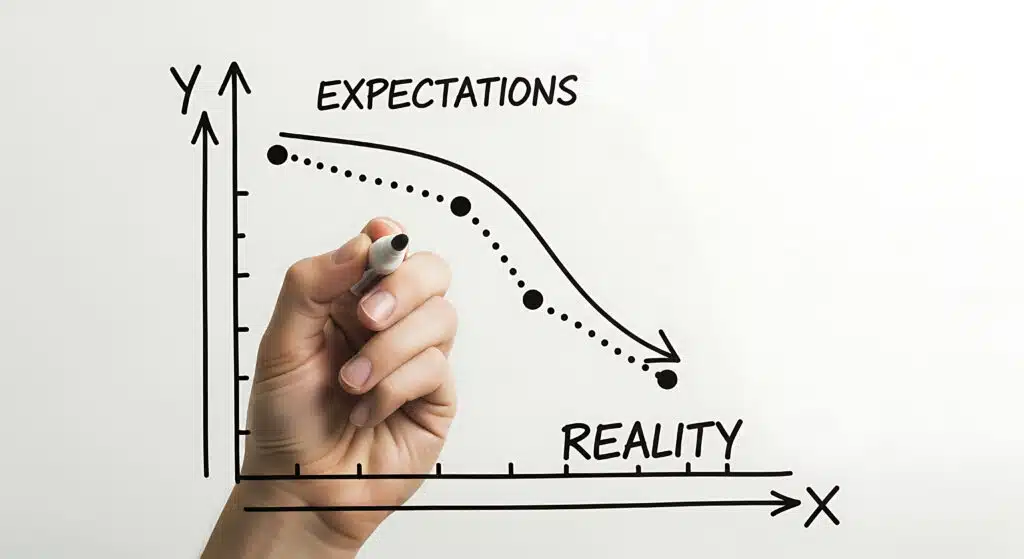
The 2025 Bentley-Gallup Business in Society Survey found that 87% of Americans believe businesses have a great deal or some power to positively impact people’s lives. Only 60% say businesses are effective at doing so. That space between what people believe business could contribute and what they see it delivering is not a marketing problem or a reputation problem. It is the public, in its own words, naming the exact reversal I keep finding inside strategy rooms. They can see the potential for contribution, and they can see how much of it goes unrealized.
I want to be careful about how this figure is used, because it is easy to overreach with it. This is public perception data, what people believe about business as a whole, not a measurement of what any single organization’s strategy is or isn’t delivering. It doesn’t prove your plan is failing. What it does, and does powerfully, is confirm that the disconnect between potential and delivered contribution is real, widely felt, and visible from the outside. The people you are trying to create value for are already sensing when a business is organized to extract rather than to contribute. They are keeping that score whether or not it appears on anyone’s dashboard.
Raj Sisodia, whose work on conscious capitalism has spent years making the business case for exactly this, argues that companies built around a genuine higher purpose tend to outperform over time precisely because purpose drives the performance rather than trailing behind it. You do not have to adopt any particular movement to take the underlying point. You do not need to throw over growth for pie-in-the-sky vision, which is why equilibrium in strategy is just as important. The point here is that leaders who treat contribution as the strategy, not the byproduct, are not sacrificing returns for virtue. They are sequencing the two correctly, and the returns follow.
What This Changes for You
The practical shift here is smaller than it sounds, which is the good news. Reordering strategy around contribution does not mean throwing out the planning process you already trust. It means adding a question that most processes never quite ask, and asking it before the revenue targets get set rather than after.
For your next strategy review or refresh, resist the urge to box the conversation in by deciding financial targets first. Instead, start with what the organization is here to contribute, to the people it serves, to the people who do the work, to the larger system it operates inside. Get specific about it. Then let the strategy design itself around producing that contribution at a level the market will recognize and reward. The revenue targets do not disappear. They get repositioned – and often sharper – as the measure of whether the contribution is working, which is a far more useful thing.
This is also why the shift does not require tearing up the work you have already done. Adding the contribution question to an existing plan tends to surface the gaps that were hiding in plain sight. An initiative that looked essential when the only test was revenue impact suddenly has to answer a harder question: what does this contribute, and to whom? Some initiatives answer it easily and get stronger for having been asked. Others turn out to have been chasing the number directly, with no clear contribution underneath them, and those are precisely the initiatives that tend to stall in execution and get blamed on the people carrying them out. The reordering does not replace your planning process. It gives that process a way to catch its own blind spots before they become next year’s execution failure.
When a plan is built in this order, the effects show up quickly. The work starts to feel meaningful to the people doing it, because they can see what they are contributing to rather than just what they are being asked to produce. Priorities clarify, because contribution gives you a way to tell the essential few from the merely urgent. The strategy also becomes more resilient, because it is anchored to something more durable than a quarterly figure that shifts with every market cycle.
The number still matters. It always did. It simply belongs at the end of the logic, not the beginning, as the result of contribution, not the substitute for it. Get the order right, and a great deal that looked like an execution problem turns out to have been a design one all along.
Quantum Intelligent Strategy is an invitation to radically disrupt the business-as-usual mindset.

Curious whether your own strategy is built in the right order? The Strategy Stress Test walks you through where your plan’s foundation is solid and where the sequence may have quietly reversed.
Erin Sedor is a strategic planning and design expert with more than 30 years of experience in helping senior leadership teams hone strategy, risk, and resilience capabilities. She is the creator of the Essential Strategy Formula, a Quantum Intelligent approach to strategy, enabling conscious leaders to build equally conscious strategy.
