
The Energy Pathways Your Org Chart Doesn’t Map
A few weeks ago, I went to an acupuncturist for something called De Quervain’s tenosynovitis, which was basically causing pain in my thumb, wrist and forearm. (Fun fact: it’s also called ‘mommy’s wrist’ since it often comes from picking up children, and my habit of hoisting my three young grandchildren is exactly how it started with me.) It had been nagging me for months, getting better for a bit but then flaring back up. After a run through of all the usual treatments, the low-grade ache coupled with periodic sharp stabbing pain got annoying. I probably could have given it more rest, but honestly, who is going to stop picking up grandbabies!? On top of the aggravation, I realized I had been favoring that hand long enough that the muscle in my left arm was slowly shrinking, not to mention three shades lighter than my right from a lack of sun because of the brace I was practically living in.
So, I found myself in the office of a local practitioner, well trained and credentialed to give Western medicine a run for its money. I know just enough about acupuncture to understand that it can work by moving blood and healing into hard-to-reach places, and tendon sheaths certainly seem to qualify. As I lay down on the table, I was fully expecting a pincushion situation in my left thumb and wrist right where it hurt. Instead, two needles went into my scalp. Then three in my right arm. Three more in my right leg. A couple in my left foot. By the time she was finished, I had needles in almost every part of me except the one that hurt. Not a single stainless steel filiform poke to my left wrist, my forearm, or hand.

I asked about it, because of course I did. The answer had to do with meridians, the channels that carry energy through the body according to traditional Chinese medicine. What she was practicing has a name: distal point acupuncture. The principle is that a local point treats the site of the trouble, while a distal point, placed well away from the pain but along the same channel, acts on the whole pathway. The place where I felt the ache was not, in her reading, the place where the trouble lived. Treating the wrist directly would have been treating the symptom. The channel that fed it ran through various other parts, and that was where the work needed to happen.
There is also a practical reason in focusing on points so far from the pain, one being that the wrist is often the worst place to work. When an area becomes fully inflamed and painful, there is also guarding to protect, a bracing against being touched. In short, it can be very difficult to receive help at the site of the injury. The logic, my acupuncturist shared, is to go upstream, leveraging and strengthening points within the same meridian channel to bring blood flow and circulation back to a place that has been compensating for so long it has half forgotten how to heal. What struck me, lying there counting needles in my foot, was how familiar the entire thing felt, not from a prior session, but in the way I have seen energy pathways run through organizations. I knew exactly what it was like to go looking for the source of pain and find it nowhere near where the symptom was showing up.
One Entity, Two Maps
Here is the thing about the body that the acupuncturist understood: there is more than one way to map it, and the maps do not show the same things. We all learned The Bone Song as kids (the knee bone’s connected to the thigh bone, the thigh bone’s connected to the hip bone…). Modern medicine has been able to define the most extraordinary maps of organs, systems, muscles, and so on. They are precise, verifiable, and when something stops working well, they can tell you exactly where to look.
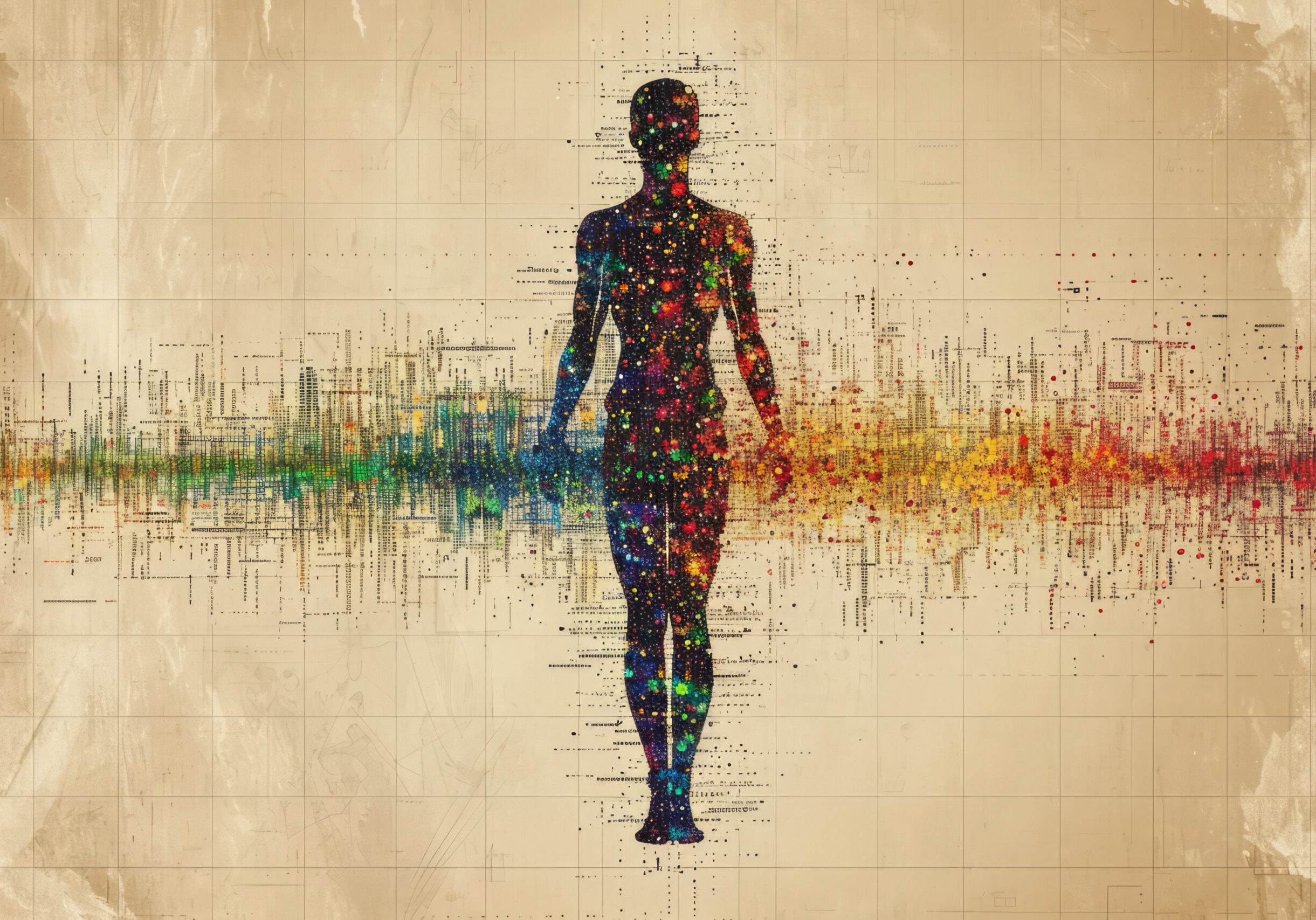
Meridian theory draws yet another map of the body. It is a map of pathways, lines that run across the anatomy, linking a point in the foot to something happening in the wrist, connecting places the anatomical chart shows as seemingly unrelated. You can lay the two maps over each other and they describe the same physical person, but they connect the dots in a different way. One shows you the organization of things. The other shows you the energetic flow between them.
The acupuncturist was not ignoring my wrist. She was reading a relationship that the anatomy diagram does not contain. The pain was real and it was located exactly where I said it was. But the pathway feeding it did not respect the boundaries of the anatomical map, and if you only had that map to work from, you would spend your whole appointment putting needles in the one place that would do the least amount of good.
I suspect you already know where this is going.
Your Org Chart is an Anatomy Diagram
Your organization has an anatomy diagram too. It is called the org chart, and it is a genuinely useful document. It shows you the parts and where they sit. It tells you who reports to whom, where authority is located, how the structure is meant to hold together. When you need to know who owns a decision or where a function lives, the org chart is precise and verifiable in exactly the way an anatomical map is.
It is accurate, but also incomplete.
Your organization does not actually run on the org chart. It runs on the pathways between those people and functions defined on the org chart. Pathways where energy genuinely moves, where a decision made in one corner travels in rapid and often unexpected ways, surfacing as a breakdown three departments away with no reporting relationship to it at all. Those pathways are real. They carry the actual pulse of the organization. And they are almost never consistent with the lines drawn on the chart.
This is the quiet reason so many leaders end up treating symptoms and not causes. A symptom surfaces somewhere visible – a team that keeps missing deadlines, a function that keeps losing good people, an initiative that stalls no matter how many times you restart it. The instinct, a completely reasonable one, is to intervene right there, at the site of the pain. You reorganize the team. You replace the manager. You put more resources against the stalled initiative. But the trouble resurfaces in the same or similar fashion, because the cause lies somewhere along the pathway that feeds it, not where it surfaced.
Separating the Symptom and the Cause
It is worth slowing down on the mechanism here, because “find the root cause” is easy to say but less easy to actually do. In a living system, the symptom and its source may seem completely unrelated, yet they are connected by energetic pathways.
Take the team that keeps missing deadlines. On the surface it looks like a performance problem located inside that team. But follow the pathway. Two levels up, a resourcing decision was made months ago that quietly stripped the team of a capability it depended on. It was probably not dramatic, just a reallocation that looked sensible on paper. The team absorbed the loss by compensating, much the way a body absorbs a small injury and keeps going. They worked around it. Then they compromised. First small things and then bigger things just to keep up. Until it all simply failed and missed deadlines became an inevitability. Now, you can replace every person on that team and the deadlines will keep slipping. The pain point emerged in a part of the organization with no visible connection to the decision that caused it.
Let’s take another one, the initiative that keeps stalling. In classic form, execution failure is deemed the cause, so you push harder on accountability, reporting, and timelines to make sure those on the front lines understand the expectation to deliver. Again, follow the energetic pathway. What you find is two senior leaders who have never openly disagreed about the initiative but have never actually aligned on it either. They are cordial. They are professional. They also never appear in the same meeting having genuinely resolved the elephant in the room, and every person one level down knows it. Nobody commits. Everybody passes it off. The stall continues. The unspoken conflict is the source here, and no amount of performance management will work until it’s resolved.
This is how a living, complex adaptive system works. It is entangled, which is a more exact word than connected. The parts are not independent components that occasionally affect one another across clean lines. They move in response to one another constantly, and a disturbance in one place propagates along the pathways until it surfaces somewhere that looks, on the anatomy chart, entirely unrelated.
This is not a fringe idea.
Thought leaders like Wheatley, Zohar, and Kilmann within and across complexity science, physics, and management theory have spent decades making the same case from different directions: that organizations behave as complex, adaptive, interconnected systems rather than as machines with separable parts. Complexity researchers like Geoffrey West and Neil Johnson have traced the physical laws that govern how living, scaling systems actually behave, and the short version is ‘unpredictable’.
The most important lesson to learn here is that most of our management tools were built for the machine model organization, and they quietly fail us when applied to the dynamic, living, and evolving thing your entity is.
Reading the Energy Map: Organizations as Living Systems
So why is this so hard to see from the inside?
Not because leaders are not smart enough. The machine model loves to reach for individual failure as the explanation, and it is almost never the right one. The reason the source is hard to find is structural. You are standing inside the entanglement, looking at the pain point. The symptoms are vivid and they are pulling your attention exactly where the anatomy chart says to look. That is not bad judgment, it’s simply limited perception. The pathway that would explain the disconnect runs behind you, or beneath you, or across a boundary you have no reason to look past.
But if you are unaware, the one thing guaranteed to hold your attention is the symptom itself. Train yourself to see the symptom as information rather than as the problem to be stamped out. Notice where symptoms surface, and then follow the pathways, all of them. By holding the whole system in view rather than hyper-focusing on the immediate and obvious, you begin to see the relationships between the parts as clearly as you see the parts themselves.
This is what I call Quantum Intelligence, the recognition of the quantum nature of the world we live and work in, together with the capacity to apply that understanding to the entity you lead. Organizations are not machines. They are living, learning, and self-evolving systems. It is not mystical or mysterious. It’s perception.
What Your Org Chart isn’t Showing You
If I handed you your org chart right now and asked you to identify where your organization was experiencing critical pain points, you could probably do it in a few seconds. Most leaders can. The harder and far more useful question is the one the chart cannot answer: what pathways feed the pain points?

Your organization is a living system. It’s entangled, it’s adaptive, and it will keep surfacing its real disconnects in places that look unrelated to their source, because that is what living systems do. The org chart will keep telling you where the parts are – clarity comes from paying attention to how they move, interact, and respond to each other.
If you want to start reading your organization as the living system it is, The CEO’s Guide to Quantum Intelligence walks you through the shift in perception that makes the pathways visible, based on more than 30 years of experience navigating complex organizations.
Erin Sedor is the founder of Black Fox Strategy and the creator behind the Essential Strategy Formula and the Quantum Intelligent approach to leadership and strategy.
