

Resilience by Design: Strategy That Bends, Not Braces
What do you fear?
It’s a loaded question, and one meant to make you pause and step back from the work in front of you right now.
Fear arises when uncertainty is high and there is something to lose. The greater the responsibility you carry, the more there is at stake: your reputation, your aspirations, and far too often your sense of self-worth.
As a leader, you must balance the needs of yourself, your team, and the organization, and we have been taught to believe these things live in different, and often conflicting, realms. As leaders, we were taught to brace for hard decisions, prepare to make sacrifices, and the reality of the no-win scenario. We learn that resilience is something we gain from hardship, the strength to be had from surviving, the test of our mettle in pulling out a crash landing and living to tell the tale.
But what if it’s all a lie?
What if along with fear, excitement and opportunity also arise in uncertainty?
What if you and the people you lead can thrive as part of, and not in spite of, strategic success?
What if the no-win scenario is one of your own making?
The speed of today’s business world drives an unhealthy urgency in how we lead, and it raises the bar on awareness, intentionality, and contributive purpose. Resilience is not something you build separately for, it is an innate element of the strategy itself, a natural extension of growth and contribution. Unfortunately, because of the negative connotation of the word, it is most often quietly avoided in strategic planning because, quite honestly, growth is more fun to talk about.
But here’s the thing – the best way to develop organizational resilience is not by creating a resilience plan – it’s by creating the conditions that allow that strength to emerge, and that starts with building proper context within strategy.
Context is how we create shared understanding about what we are trying to solve, or from a strategic perspective, why the entity exists and how it chooses to meet that objective. Defining context for the purpose, growth, and evolution of the entity as the foundation of strategy naturally creates this space for resilience to develop.
The No-Win Scenario We Build for Ourselves
We didn’t arrive at the brace-for-impact version of leadership by accident. We inherited it. For a century we were handed a picture of the organization as a machine to be optimized and defended, set against a world assumed to be hostile. Build the plan, protect the plan, and when the shock comes, absorb it and prove your strength by still standing. In that picture, resilience can only ever be the aftermath. It is what you have left once the crash is over. You cannot design it in, because the whole model treats the future as something that happens to you versus something you create with the collective energy of your organization.
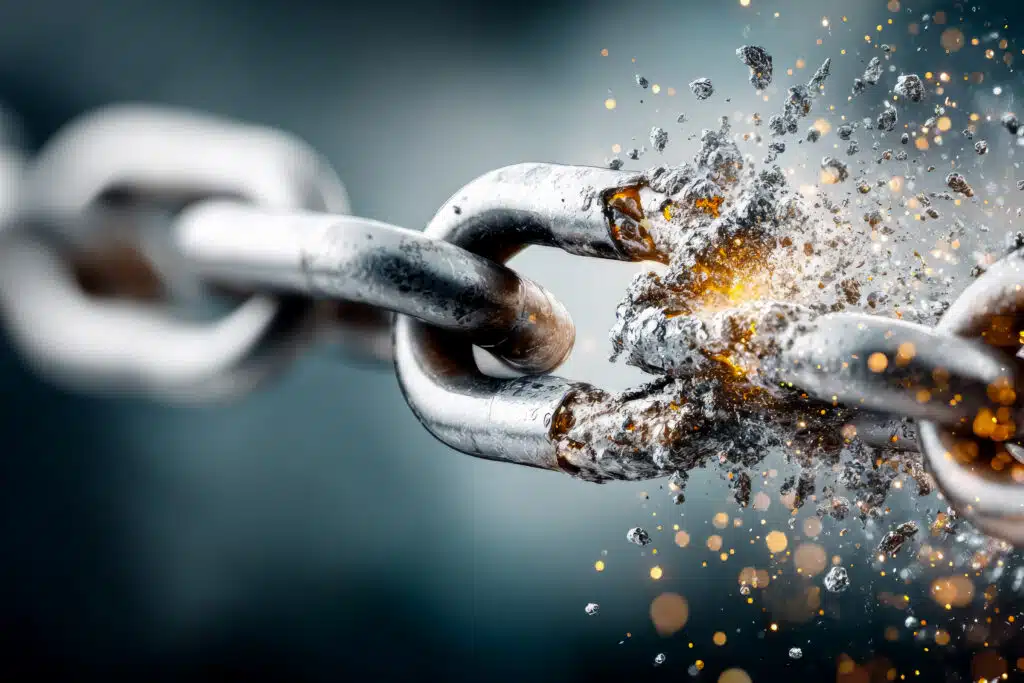
Notice how that model I described quietly affects you as a leader. When the plan is built from a predominantly external perspective, taking its cues from the market, your competition, and anchoring primarily to a financial outcome, it has nothing of its own to stand on. It has no foundation. So, the plan braces. You brace. Your team braces. Every external signal becomes a threat to defend against, and defense is exhausting in a way that building something of substance never is.
The no-win scenario doesn’t come from a hostile world. It comes from building a plan that assumes machine predictability, that treats the world as something to be won over instead of something to grow through. A strategy whose stability lives entirely outside itself is nothing more than a house of cards, and that is not why you showed up to build.
Resilience by Design
The alternative isn’t a sharper version of the same framework. It is a different design entirely, one where resilience is present from the beginning, infused within the plan design rather than developed on a separate track.
The physicist Geoffrey West spent years studying why companies age and die while cities almost never do. His finding, laid out in Scale, is that organizations tend to calcify: they optimize so tightly around what is working that they trade away the slack they need to adapt when conditions shift, and that lost slack is what eventually ends them. Cities stay open-ended, always leaving room for what comes next rather than locking themselves around the last thing that worked. The lesson in building better strategy is understanding that adaptive capacity is structural. It is woven into how the thing is built, or it is not there at all. You cannot bolt it onto a finished plan any more than you can slide a foundation under a house that is already standing.
Resilience as a design element means the plan anticipates its own evolution: what would have to remain true for this to hold, and what will we do if it stops being true. Those questions live in the foundation itself – the context that defines purpose, growth, and evolution for the organization. Is the way we deliver our purpose still relevant? What does the organization need? Are we anticipating evolution? A plan built in this way holds and flexes where it’s needed. That’s the opposite of bracing for impact, and it’s within reach of any organization, including even the smallest ones.

The Necessary Foundation
You can only weave resilience through a plan if the plan is built from the inside out, from the organization’s own purpose, its real capacity, and its intended direction of growth, rather than assembled from an external wish list. Purpose, growth, and evolution, managed in equilibrium, is not a flourish and it’s not conceptual. Instead, it is this context that gives a strategy its own center of gravity, and that creates resilience by design.
There is an ancient principle underneath all of this: the Law of Correspondence, the recognition that what you build internally shapes what you experience externally. As within, so without. An organization clear and coherent on the inside meets a turbulent market as simply a thing to navigate. An organization scattered on the inside experiences that same market as chaos.
It also dissolves the false belief that the needs of the leader, the team, and the organization live in separate and competing realms. That conflict is a symptom of the backwards outside-in design, where the plan serves an external target and to reach it, the people within are spent. Build it correctly from the inside out, from purpose and contribution, and the arithmetic changes. The leader, the team, and the organization thrive as one system or not at all.
You can see it most clearly in the organizations that have survived the unsurvivable. Writing in Harvard Business Review not long after September 11, Diane Coutu identified shared meaning as one of the deep sources of resilience: organizations endure less because of the resilient individuals inside them than because of the values they hold in common, the sense that people belong to something larger than their own circumstances. That kind of culture is not installed after the shock arrives. It is built quietly, in the ordinary work of defining what an organization is for and whom it serves, long before it is ever tested.
The Perception of Speed
The elements that define organizational success haven’t changed. What has intensified is speed, and the urgency it manufactures. Notifications, dashboards, and the constant hum of everyone else’s announcements create a sense that the ground is moving faster than any plan can keep up with, and that feeling pushes leaders to trade intention for reaction.
Urgency is not the same as importance. A braced, outward-anchored plan converts every fast-moving signal into a demand for an immediate answer, which is how a leader ends up working harder than ever and steering less than ever. A plan designed with a solid foundation tempers the urgency created by the speed of business because it defines what the organization is for and what it can carry. A solid foundation supports the capacity to tell the difference between a signal that matters and noise. The pace outside becomes information to weigh rather than an order to obey. That discernment is what intentionality and purposefulness buy you, and resilience woven into the design is what makes the discernment possible.
What It Looks Like in Practice

None of this is abstract, and none of it is more work. It is earlier work. Take a bet almost every leadership team is weighing right now – a commitment to fold AI into some core part of the business over the coming year. Typically, it shows up as a bolted-on goal, a target and maybe a budget inside the plan. Designed with resilience woven in, it carries its own signals from the start: the value of the integration to the health and success of the organization, together with the two or three conditions the integration depends on.
The bet is the same size. What changed is that the team was intentional, the plan flexed, and the decision recalibrated both priorities and capacity to support it. Multiply that across the handful of real bets inside any strategy, and resilience stops being a quality you hope miraculously emerges. It becomes a property of the plan, present in every facet, exactly as the opening promised: a natural element of growth and contribution rather than a wall you throw up when growth begins to break everything in its wake.
From Bracing to Strength
Return to the question we opened with. What do you fear? The honest answer, for most leaders, is some version of losing what they have built. That fear is not irrational, and it does not disappear. What changes is how you respond to it. Uncertainty is not a container for loss; it simply holds possibility, and the design of your strategy decides how much of that possibility you can reach. Build resilience into the foundation and you meet what comes next turned toward it, not braced against it but ready to grow through it, so that you and the people you lead thrive as the organization thrives.
Resilience isn’t set once; it holds only when purpose, growth, and evolution stay in equilibrium as conditions change. Keep them there with QI Performance Navigation, the year-round advisory partnership built for exactly that.
Erin Sedor is a strategic planning and design expert with more than 30 years of experience in helping senior leadership teams hone strategy, risk, and resilience capabilities. She is the creator of the Quantum Intelligent Strategy Formula.
